Friday, October 2, 2015

Seoul Day Five

Seoul Day Five

Woke up to a beautiful day in Seoul -- the sun is shining, and the heavy rain yesterday has made everything sparkle.

The opening keynote today is by our own the Most Rev. Katharine Jefferts Schori, Presiding Bishop. "The world needs the confidence that peace is possible." "Reconciliation is the foundation of God's mission." Always a gifted preacher and teacher, our Presiding Bishop talked eloquently about the efforts of peace making and creative ministry that are in process throughout this area of the world. TOPIK -- bringing together old enemies in talks of peace and reconciliation. In other areas, addressing climate change, over mining and fishing -- offering lament, calling attention to the wrongs done to the environment and the various group's responses to these abuses. This is but a small offering of the myriad list of efforts of EAM communities in this region. "EAM communities are inviting us to put a new virus in our DNA -- to see our neighbor not as an enemy but as a friend." "The violence of this world is  born of scarcity." 

The Rev. Bayani Rico addressed the group -- asking for those who attended the workshop on Social Ministry in Korea -- there are more social ministries in Korea than there are Anglican Churches in Korea -- it is a focus of their work in the world.  The Foreign Laborers Center was awarded a gift of money from EAM -- Fr. Columba accepted the gift to support the ministry of the center. I had visited there four years ago -- it is a rich and complete ministry.

Our own Aidan Koh introduced the Rev. Dr. Jeremiah Yang to the group.  Jeremiah began his speech by apologizing for his English -- which he did not need to do -- he speaks beautifully. His reflection on    spirituality   is linked to mission shaped spirituality. Mission shaped church is a work to restore the missionary nature of the church. If done, it can reform and reshape the church -- it is a new approach to spirituality. He talked with us in depth about the ferry disaster last year which I will try to capture here -- 250 high school students were among the dead. Students in the sinking boat in their last minutes exchanged text messages with their families and friends -- sharing their last thoughts with those they love. It was gruesome torture for those who couldn't do anything to help them -- their loved ones. It was two hours of self-reproach and agony for those following the event. A few days later people began to realize that the disaster was avoidable -- behind the disaster was corruption, bribery and political and business power. Many theologians in Korea were condemning the underlying theology of the company owner -- which was tied to a theology of capitalism and collusion of a distort Christian spirituality -- its underpinnings was a prosperity gospel tied to capitalism. 

Korean churches responded to the disaster with relative silence -- not questioning what happened -- thinking it was an accident. They did not mourn with the victims families and friends. Easter Sunday fell just 4 days later -- most churches preached and celebrated Easter as usual -- they lost the ability of mourning and reflection -- the loss of the ability to mourn was a great issue. The chair of the Christian Council questioned later why poor students were going to Jeju Island -- a form of continued coverup of the truth of the disaster -- blaming the victims -- criticizing the victims and their families. Families are still wanting to know exactly what happened and what will change in the future. Jeremiah went on to say that we become real human beings when we develop the ability of listen, lament and mourn. God listens to those who mourn -- that is our model -- not sweeping emotions under the rug, but looking at the situation, listening to those who mourn -- lamenting and mourning with them, and then working to change the situation or structure that caused the pain. This is the work of the church. This is the starting point of transformation -- let us move to mission, restoring the nature of the mission of the church -- restoring our missionary heart, our mission shaped church, which listens to and mourns with those who suffer. 

A question and answer session followed with the two keynote speakers. 

We piled into busses afterwards and headed on the one and one half hour drive to Gang Hwa -- the Iona of Korea. We were greeted warmly by Bp. Kim, the retired Bishop of Seoul. This is his home town. We walked to the parish hall and enjoyed a delicious lunch! This church is named WARM WATER
CHURCH because that is the name of the city (this is translated into English).  We had a delicious lunch made and served by members of the parish. You can see me and some of the ladies in the selfie -- they particularly were amazed that I am a woman bishop, and one of them took a picture of my ring!

After lunch, the Rev. Moses Im offered us a history of the church in this area -- one of the oldest in the Province.  The church we were in is relatively new building, with the original church which is over 100 years old nearby. September 26, 1890 the Bishop arrived in Incheon port -- the Bishop began his mission in Seoul and Incheon. He founded orphanages and other forms of mission including medical
ministries. Priests found this island and felt that it would be a starting point for the Church. In 1893 he walled a small house here. 

On Ganghwa Island there are 12 Anglican churches, and 150 Methodist churches!

We are actually on the South of the Island sitting in the church -- we will be heading out to a point farthest north where we can see North Korea. 

At the farthest north point we visited the Peace Wish Park, with it's overlook of North Korea. It seemed so close that you could just swim a little bit and get to it! It is always a bit sad for me to be in a place like this -- to think about and reflect on the separation of families. There was music playing -- Aidan told me it was a sad song (a lament) -- about the people who can't see their beautiful mountain (it is in
North Korea). It was a sad song, and it kept repeating. It was absolutely beautiful up there after the rain -- and it was a peaceful scene on both sides. This tranquility was broken when I looked down towards the shore and saw barbed wire. 

The church we visited next (the original one) was constructed by Charles John Cofe, the inaugural Bishop in Korea in 1900 in commemoration of Koreans who had been baptized in 1896 in Ganghwa island for the first time -- this was the first set of baptisms on the island! The church was named for Sts. Peter and Paul. A royal architect lead the work project. Several renovations were done in the years since, but it still remains in its original form. This building site resembles the Ark, demonstrating the
church's image of salvation. Based on the Korean traditional style, this rectangular shaped church applies the Basilica style to its placement and interior, representing the beauty of harmonization of western and Korean aboriginal architectural techniques. We were greeted very warmly here and shown the grounds and given this history of the church. It is small on the inside but really beautiful!

We went down to the parish hall after our tour of the small church campus (upper campus). The parish hall is a more modern, multilevel building where we enjoyed a delicious dinner! The parish members were very friendly and helpful. They kept wanting to give me more food! Bibimbap with lots of veggies, a salad, glass noodles....yum!

After dinner we got back into our buses for a short ride over to the auditorium where we saw a cultural presentation on Korea. We heard traditional instruments playing traditional (and some more recently
composed) pieces. The woman who played the haegeum -- a two stringed bowed lute was especially amazing. A Gayageum was also played -- it looks like a large zither. Another performer played something that looked like a penny whistle -- but the sound was amazing. Drums of course were played. After four traditional pieces were offered, a keyboard, electric base, guitar and drum set were added and fusion music including the traditional instruments was offered -- beautiful! These are very talented students/musicians!

We left there about 9 pm for the hour long drive back to the cathedral and then the walk back to the hotel. It will be an early morning and a long day tomorrow. I wonder what the 125th anniversary Eucharist in the morning will be like?


Thursday, October 1, 2015

Seoul Day Four

It rained hard as we were waking up -- the streets were already soaked -- and the sky was dark with clouds. Glad I brought my water proof walking shoes!

We entered the Cathedral through a welcome group of Korean Drummers. The day began with a Eucharist -- the Presiding Bishop presided, Fred Vergara preached. The Mother's Union served as our choir (BEAUTIFUL voices!). It was a great start to our day. Our own Peter Huang read the gospel in
Mandarin. It was moving for me to be back in the Cathedral in Seoul, sitting in the nave, looking up at the beautiful chancel with friends and colleagues sitting together. It was a kaleidoscope of faces -- most of whom I know, gathered together in a different part of the world to hear the word of God, to celebrate as a part of Episcopal Asiamerica Ministry, and to help with the celebration of the 125th anniversary of the Anglican Church in Korea. Today the focus was on EAM primarily -- the time for the celebration fully of the 125th anniversary of the Church of Korea will be Saturday.

The Most Rev. Nathaniel Uematsu began the keynote address with part of his story of reconciliation. While I have heard most of it before, I never get tired of hearing it -- of being reminded, as he so aptly put it, "Admitting our own guilt and sin is the hardest thing. But only when we've done this can we go forward and experience the blessing of reconciliation." He spoke about the work between the Anglican Church of Japan and the Anglican Church of Korea. He spoke of silence in the face of injustice. He offered a picture of the history of his church, and shared his own experiences in dealing with that history and the history of his country. It was moving and important for the EAM members to hear sitting in that Cathedral in Seoul. 

Bishop Allen Shin, Suffragan in New York then spoke about the history of Asian Ministry in The Episcopal Church -- dating back over 100 years. Our own St. Mary's Mariposa was spoken about in this context, and the history of Asians in America. Demographic information was offered as well -- we know, for instance, in the Diocese of Los Angeles the fastest growing demographic is in the Asian community. Among the most profound and moving statements Allen made regarding reconciliation was this: "The heart of reconciliation is honoring the dignity of difference." Indeed, it is!

Various workshops were offered in the afternoon -- everything from General Convention Highlights and Updates, Episcopal Church in the Philippines -- Asset Based Mission and Community Development,  Mission Enterprise Zone, Social Media: Evangelism in a Digital World, Social Ministries in Korea, Racial Reconiliation, and last but not least Meditation and Healing Korean Style. I made the decision To attend the Meditation Korean Style and the Racial Reconciliation workshop. 
The Rev. Sr. Catherine Oh offered the workshop on Meditation Korean Style, and it was a pleasure and honor to attend that with her. We meditated on scripture together, taken 10 minutes to sit and silence and respond inwardly to the scripture that had been read to us twice through. It was the fastest 10 minutes I've spent in a long time! We were then asked to talk to the person next to us about what we experienced during our meditation -- it was profound. Two forms of meditative dance were then taught to the participants -- the Elm dance and one other. Beautiful!

Heidi Kim from The Episcopal Church then offered the workshop on Racial Reconciliation. As always, she was on point and to the point with talking about racism and the way it is or is not dealt with. She summarized the work offered in the opening keynote addresses and knit her work in this area together with the earlier addresses beautifully. She pulled out the two quotes from each of the keynoters that I quoted above -- indeed they were the same quotes that struck me as they struck her. We still have so much work to do as a church with regards to racial reconciliation -- much work to be done. 

Dinner followed this last workshop -- a lovely dinner indeed! I didn't take a picture of it because, well, I forgot to. 

The Rt. Rev. Stacy Sauls offered a very different kind of reflection that what he was asked to. This was his first time back in Korea in 28 years -- it was 28 years ago that he traveled to Seoul to pick up his adopted son Matthew, who was 4 months old. He told of the beauty of seeing Matthew for the first time. He spoke about the ordeal in getting him home, by himself (his wife Ginger was home with their son Andrew who was also adopted from Korea). He spoke about learning about racism dealing with his own children and their reality as Asians -- everything from not being able to join a local cub scout troop to being assumed to be smart at math because they are Asian. It was a particularly moving story and he had me in tears. 

Next was "open mike" -- questions for the bishops. Then the bishops were given the opportunity to ask questions back to the group. It was a great discussion of various topics.

It's going to be another long day tomorrow -- I wonder what new insights I'll gain? Can't wait!


Wednesday, September 30, 2015

Seoul Day Three -- and the Beginning of the Meeting

It seemed as though I had just fallen asleep when it was time to wake up -- perhaps because I slept long and soundly!

We met the group for breakfast at 7:00 am (no early morning Eucharist for me today). Other friends are beginning to show up as well. I invited Scott Hayashi to join us on our adventure today. The only one from our group who couldn't make it was Anna Olson -- she was meeting our friend Francis today. 

We set out at 8:30 and we walked along the main boulevard towards the Big Palace (Gyeongbokgung Palace). Along the way we stopped at my favorite "water feature" which is the lower level river right off the main boulevard. I always know where it is by the shell-like structure at the boulevard entrance to
the water.  We walked along the water's edge, admiring the umbrellas and other beautiful things to see -- such as the umbrellas hanging with some kind of message on them. 

We then crossed to the middle of the boulevard to admire the statues of Admiral Yi Sunshin and King Sejong the Great, two very important men in Korean history (you can look up their stories if you'd like -- I'm not writing it all out here). The statues are ginormous, as I am fond of saying. The air was cool this
morning and the large crowds we encountered the last few days were much fewer in number.

We finally made it to the Palace! I'm not quite sure why, but today it was free admission for not only the Palace but for the Folk Art Museum as well. We walked around the palace grounds and admired the workmanship of the buildings. It wasn't very crowded so it was easy to take pictures and spend a bit
of time looking around. We did make it over to the folk museum -- I hadn't been there in 4 years! Right outside there was the Chinese zodiac statues -- I found the monkey (my sign for my year). Too cute!

Anna reminded me that at the entrance to Insadong (at least one of the entrances) is a giant paint brush. It's more the a mouhbat -- a brush pen for calligraphy. We turned in there and waked up into Insadong. We were along the same road we were on yesterday. Another stop at the scarf store for one
for my twin to match the one I got for myself (it is a good color for us). We also went to an art store that featured silks and hand embroidery. I found some beautiful mirrors for gifts that were hand embroidered on one side! We then went on to look for a specific kind of pillow in the shape of a cube for Kate (she saw one in the Folk Museum I believe). Steve finally was able to get his fried donut (there was a LONG line there yesterday and he couldn't get one - bummer! It has some kind of beans in it -- I would describe it as sweet and savory!

While the group was helping Kate search for the pillow she was looking for, I went over to the information booth. I asked the woman there if she could help me find the restaurant and the tea house I was looking for yesterday with Fr. Columba. I described the sign outside the Shabu Shabu restaurant: "there is a sign with a short man on it -- cartoon like -- and he has crazy hair." She immediately knew what I was talking about, called it up on her computer, turned the monitor around and let me see it -- yes, that was it! Shabu Shabu was in my future! I felt confident in her abilities so I asked her to look up the tea house -- it was only one street over from the Shabu Shabu restaurant. So off our group went. 

We got to the restaurant and our "little" group of 8 ordered shabu shabu -- Scott Hayashi took care of the cooking on one side of the table, and Ken Chow took control of the other pot on the other side of
the table. Within a few minutes, the food was cooking in a delicious broth and we were enjoying each other's company and the wonderful shabu shabu! This is on road 8 in Insadong.

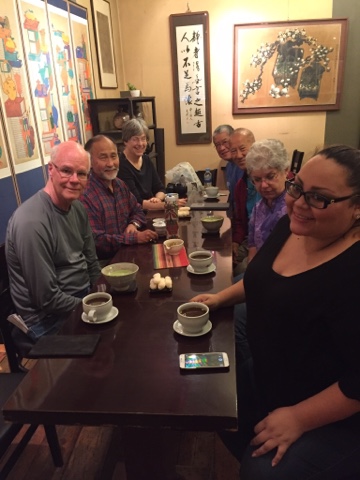
After our lunch we found the tea house -- yes, it was the one I was looking for! It is on road 10 of Insadong -- like road 8 it is really a narrow alleyway. At the end of a museum is the part open/part enclosed tea house. Four of us had jujube tea -- delicious! Two had green tea (one with milk). One had Chrysanthemum tea, and one had ginger tea. Delicious! It was packed outside so we sat inside. It was a delightful, refreshing experience, and I was so happy to find those two places. Everyone seemed to enjoy the food and the tea.

We then got into cabs and headed over to the hotel. The rest of the group moved over to the hotels they were staying at (with the rest of the EAM group). There are a few of us staying at the hotel we checked into just a few days ago. At 3:30 we met up (some but not all of us) and walked over to Namdemun. It was pretty packed, and chock full of vendors and "more stuff than anyone needs" per Steve. It was a fruitful experience (Barbara found an outfit for her granddaughter, I found a table runner, as did Kate. Barbara found a knitting bag.) A detour suggested by one of the shop keepers sent us to a "mall" with hundreds of stalls -- looking for Kate's pillow. No luck.

We said our goodbyes at the hotel and went to our rooms to shower and change for dinner. Steve and I waslked over to the Cathedral where we were greeted by old friends from all across the US and Taiwan. We registered and sat to have some water. 

The program began at 7 pm with introductions by Fred Vergara, Bayani Rico, Peter Ng, Archbishop Kim and the blessing of the food by the Senior Warden of the Cathedral. We then headed to the sub basement for dinner -- a big spread with all different kinds of food. 

We sat and ate with the Shin's and the Lai's -- good friends. Donald Rominek from ECF joined us.

We were done by about 8:30 and headed back to the hotel, which is a good thing -- I'm pooped!

I wonder what our first FULL day (and it is scheduled as a very full day) will be like tomorrow!